
Home › Dry Needling
Dry Needling
Dry needling from physiotherapists rostered with the College, used inside a physiotherapy plan to release muscle that will not let go with hands-on treatment alone.
Sahar Alhalis yasss
5 out of 5 starsThey are so good and helpful I had a good experience with them
Heeba Moukanni
5 out of 5 starsI’ve been going to medrehab group for years, their massage therapists are all wonderful and so sweet, same goes for the physios. The clinic is also very clean.
Amber
5 out of 5 starsI strained my back for the 3rd time and decided it was finally time to see a physiotherapist. Going off the highly rated reviews, I called Medrehab and they got me in the same day. I was seen by practitioner Neha Multani who was really friendly, knowledgeable and helpful. I left feeling a lot better and with some stretching exercises to do at home. I already booked my next appointment. Highly recommend!!
Anna Nicole Presutti
5 out of 5 starsLove the team at medrehab 😁 front desk staff are always friendly and welcoming even during the evening when i'm sure they're feeling tired and want to go home. Stephanie is the best :)
Paul Shapiro
5 out of 5 starsEverything that they say will take place, takes place. They don’t operate by not doing things the way they should be done.
Karen Campbell
5 out of 5 starsAll staff were greatly. Dhariniben listened to my concerns and offered options to resolve them. Looking forward to working together.
Jim Flood
5 out of 5 starsI had a message and got greedy and treated myself to chiropractic treatment. I walked out a new man. I have been suffering with my lower back for sometime now. I got brave a scheduled an appointment. My therapist did a full exam of my body then explained what treatment was required. I’m not going to say I was terrified of the unknown. I have to say I was talked through every step. I truly have to say I feel like a new man. Would not hesitate to recommend Med Rehab. 100%. I have to shout out to the girls on the front desk, they welcome you in from the moment you step into the building. Extremely friendly. What a TEAM.
Seth Quarshie
5 out of 5 starsThey’re services are top notch and I would love to recommend to everyone thank you MedRehab Group physiotherapy
Maureen Sahipa
5 out of 5 starsStaffs are accommodating.. Dr. Annamaria ( chiropractor) is so friendly and amazing!
Victor Sci
5 out of 5 starsMy wife Carmelita has been seeing Navreet. She just wanted to say that Navreet is an amazing physiotherapist. She is patient and very understanding. She explains everything she is doing and how it will help with recovery.
KHURAM SHAHZAD
5 out of 5 starsAwesome experience after transitioning from place to place find a guy who knows his job. Michael did a great work and facilitated my rehab process on muscular injuries with exceptional professional skills. Highly recommend.
M Soman
5 out of 5 starsPhysiotherapist is knowledgeable, explains the issue, and the exercises needed to resolve the problem. The facility is clean and front desk staff is friendly and welcoming.
Elizabeth Borges Reinoso
5 out of 5 starsI felt much better after my visit. Staff is incredible. I’m l looking forward for my next appointment. Thank you.
A Gamage
5 out of 5 starsVery friendly staff and clean environment!
Mario Avenia
5 out of 5 starsJane and Sheppard medrehab the staff is always amazing
Rodrigo Luz
5 out of 5 starsVery friendly environment, great staff . Always coming back
Muhammad Mudassar
5 out of 5 starsI had a great experience at Medrehab and would definitely recommend them. Ishika, my physiotherapist, has been very professional, knowledgeable, and patient throughout my treatment. Mehak, the PTA, has also been extremely helpful and supportive during my sessions. I also want to appreciate Ekam at the front desk for always being friendly, welcoming, and helpful. Everyone at the clinic makes you feel comfortable and genuinely cared for. Thank you to the whole Medrehab team for the great service and support! 😊
Eugene Gibas
5 out of 5 starsGood session, went in at ZERO comfort, went home at 100+
Lisa Roberti
5 out of 5 starsStaff here are very knowledgeable and professional.. the service is excellent ! Thank you MedRehab
Marjan
5 out of 5 starsThe staff at MedRehab Group do an excellent job of making you feel comfortable, welcome, and well cared for. Everyone there is understanding, professional, and courteous, while providing excellent service and care. Truly masters of their craft and would highly recommend MedRehab Group to anyone. Thank you to the whole team.
Bảo Đinh
5 out of 5 starsI had an excellent experience with MedRehab Group.The office staff are professional, knowledgeable, and genuinely care about their patients' recovery. The physiotherapist took the time to thoroughly assess my condition, explain the treatment plan, and answer all of my questions. The treatment sessions were effective, and I noticed significant improvement in my pain within a short period. The clinic is clean, well-organized, and appointments are always on time. I highly recommend this clinic to anyone seeking high-quality physiotherapy care.
Amir Kamel
5 out of 5 starsThis is an excellent facility that provides a welcoming atmosphere from the moment of arrival. I have been working with Elizabeth at the front desk and Jackie, the therapist, both of whom have provided an outstanding experience thus far. I would like to extend my sincere appreciation to the entire team for their exceptional service.
SIVANESAN SIVAGNANAM
5 out of 5 starsGreat service and always appointments on time
Julie Bautista
5 out of 5 starsI’ve been seeing Mohammed for Chiro and Pratchi and Sheryl for Physio for a couple months following a MVA. They truly care about my recovery and I’ve seen great improvements in my condition! Their attention to my recovery has made each session very beneficial.
Average across all twelve clinic listings. Each clinic’s own rating is shown on its location page.
Dry needling at MedRehab Group
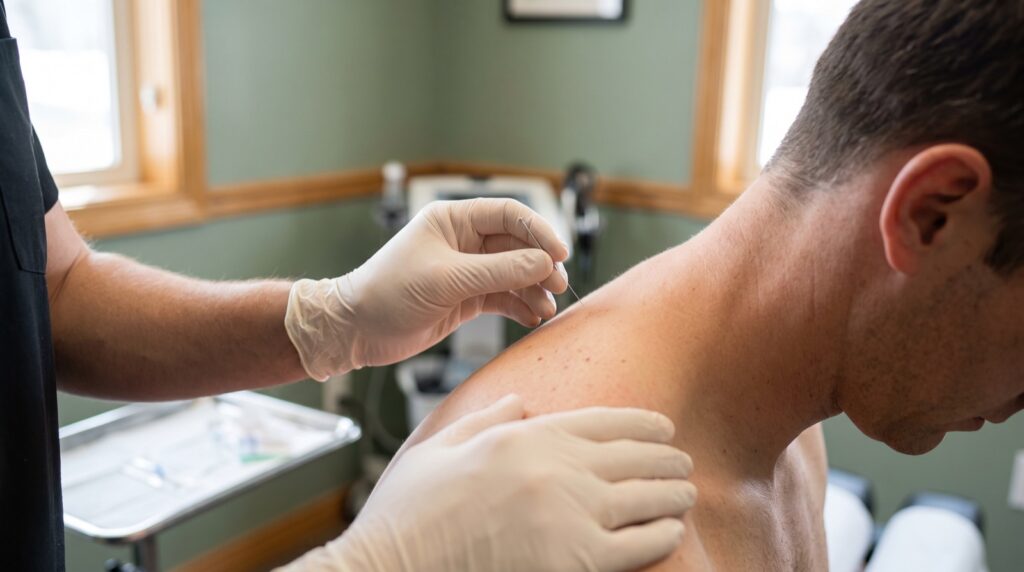
Dry needling is a technique some of our physiotherapists use inside a physiotherapy session to release a tight, painful band of muscle that has not let go with hands-on treatment or exercise. A fine sterile needle is placed into the knot, the muscle twitches and relaxes, and the area that has been guarding for weeks often eases within a session or two. It is not a separate service you book, it is not acupuncture, and it is not for everyone. Your physiotherapist will suggest it when it fits, and only after assessing you.
Dry needling is offered by physiotherapists who have completed additional training and are listed on the College of Physiotherapists of Ontario’s roster for acupuncture and dry needling. Not every physiotherapist at every clinic is rostered, so if you specifically want it, say so when you book and we will place you with someone who is.
Dry needling or acupuncture: what is the difference?
The needles look the same, which is where the confusion starts. The two are different treatments with different reasoning behind them.
Acupuncture comes from traditional Chinese medicine and places needles at points along mapped channels, often well away from where you feel pain, to influence the body more broadly. At MedRehab Group it is provided by registered acupuncturists. Dry needling comes from Western musculoskeletal medicine and places the needle directly into a trigger point, the taut, tender band inside a muscle that refers pain elsewhere. It usually involves fewer needles, kept in for less time, and it is one tool within a physiotherapy plan rather than a treatment on its own.
If your problem is a specific muscle that will not release, dry needling is the more direct answer. If you are looking for a broader approach to pain, stress or a condition that is not a single tight muscle, acupuncture is the better fit, and both are available across the group.
How it works
A trigger point is a small patch of muscle fibres that have contracted and stayed contracted. It is tender to press, it can refer pain to somewhere nearby (a trigger point in the upper shoulder muscle is a common source of headaches), and it keeps the muscle short and weak. Massage and stretching reach it from the outside; a needle reaches it directly.
When the needle enters the trigger point, the muscle often gives a brief involuntary twitch, called a local twitch response. That twitch is the sign the right spot has been found, and it is usually followed by the band softening and the referred pain easing. The current understanding is that the needle disrupts the contracted fibres, improves local blood flow, and changes how the nerves in the area are signalling. It is not injecting anything, which is where the word dry comes from.
Conditions it is used for
Dry needling is most useful for pain that comes from muscle rather than from a joint or a nerve, particularly when that muscle has been tight for a long time. The research is strongest for trigger points in the neck and shoulder: reviews find low to moderate quality evidence that it reduces pain and improves function in the short term compared with sham treatment, placebo or no treatment, and that it works better as part of a plan than on its own. At our clinics it is used for:
- Neck and upper shoulder tension, including the tightness that comes with desk work and phone use
- Headaches that start in the neck or the muscles at the base of the skull
- Low back pain where the muscles alongside the spine or in the buttock are the main source
- Hip and buttock pain from the deep rotator muscles, which can mimic sciatica
- Calf, hamstring and quadriceps tightness in runners and athletes
- Tennis elbow and golfer’s elbow where the forearm muscles are involved
- Jaw pain from clenching, where the chewing muscles hold trigger points
- Muscle guarding after an injury or a car accident that will not settle with hands-on treatment
What it does, and what it does not
Dry needling is good at one thing: releasing a muscle that is stuck in contraction and easing the pain that comes from it. It is quick, and the relief can be immediate. It does not fix the reason the muscle tightened in the first place, which is nearly always a matter of load, posture, weakness or an underlying joint or nerve problem. That is why it is never the whole plan at MedRehab Group. Your physiotherapist uses it to open a window, then fills that window with the strengthening and movement work that stops the muscle tightening again.
It is not pain free, and we will not tell you it is. Most people feel a brief cramping or deep ache as the muscle twitches, and the treated area is commonly sore for a day or two afterwards, like the day after a hard workout. It is also not the right treatment for every pain. If your problem is a joint that is not moving, a nerve that is compressed, an inflamed tendon or an unexplained pain, needling a muscle near it will do little, and your physiotherapist will say so.
Some people should not have it: anyone with a bleeding disorder or on blood-thinning medication, anyone with a needle phobia, an infection or skin problem over the area, a compromised immune system, or in the first trimester of pregnancy. Needling over the chest, upper back and shoulder carries a small but real risk of puncturing the lung, which is why those areas are needled only by physiotherapists trained in the safe angles and depths, and why you are asked to report any breathlessness or chest pain afterwards immediately.
What a session is like
Dry needling happens within a physiotherapy appointment, not as a separate booking. Your physiotherapist assesses you first, explains what they have found and why needling would help, and asks for your consent, which you can withdraw at any point. They clean the skin and use a new sterile single-use needle, much thinner than the needles used for injections. The needle is placed into the trigger point, may be moved gently in and out to provoke the twitch, and is then removed; sometimes several points are treated in one session. Each needle is in for seconds to a few minutes. Afterwards you may be given a stretch or a movement to do straight away, while the muscle is loose.
Most people need between one and four sessions of needling within their physiotherapy plan, spaced a few days to a week apart. If a muscle needs needling every week for months, something else is driving it and the plan needs to change.
Who provides it
Only registered physiotherapists who have completed recognised post-graduate training in acupuncture and dry needling and are listed on the College of Physiotherapists of Ontario’s public roster for it. The College sets the training, safety and consent requirements in its Controlled Acts Standard, and you can confirm any physiotherapist’s roster status on the College’s public register. Dry needling is never done by an assistant or by anyone who has not assessed you first.
Cost, insurance and direct billing
Because dry needling is part of a physiotherapy session, it is covered the way physiotherapy is. Most extended health plans through work cover it under their physiotherapy benefit, and we bill most major insurers directly so you pay only what your plan does not cover. It is not covered by OHIP. After a car accident it can be part of the treatment plan submitted to your auto insurer; under WSIB it can be included in a program of care. Physiotherapy is exempt from HST. Ask the clinic whether your plan treats needling as an add-on, because a few do.
Where can I book dry needling?
At any clinic where a rostered physiotherapist practises. Rosters change, so rather than publish a list that goes out of date, we ask you to do one thing: book a physiotherapy assessment at your nearest clinic and say you want dry needling. Reception confirms which physiotherapist at which clinic can provide it and places you with them. Choose a clinic from the list on the physiotherapy page or use the clinic finder. Availability at a given clinic must be confirmed at booking.
Questions we are asked most
Does dry needling hurt?
A little, briefly. The needle itself is barely felt going through the skin; what people notice is the twitch and a deep cramping ache when it reaches the trigger point, which lasts a few seconds. Expect the muscle to feel bruised for a day or two afterwards. If at any point it is more than you want, say so and it stops.
Is it the same as acupuncture?
No. Same type of needle, different treatment. Acupuncture works from traditional Chinese medicine and points along mapped channels; dry needling places the needle directly into a tight band of muscle, based on anatomy. Acupuncture at our clinics is provided by registered acupuncturists, dry needling by rostered physiotherapists.
Can I book dry needling on its own?
No. It is a technique used inside a physiotherapy appointment, decided after assessment. If you know you want it, book a physiotherapy assessment and tell us, so we place you with a rostered physiotherapist.
Is it safe?
When performed by a trained, rostered physiotherapist with sterile single-use needles, yes. Minor bruising and soreness are common. Serious problems such as a punctured lung are rare and are the reason the chest, upper back and shoulder are only needled by physiotherapists trained in those areas. Tell your physiotherapist about any medication, bleeding problems or medical conditions before you start.
How many sessions will I need?
Usually one to four, inside a physiotherapy plan that also addresses why the muscle tightened. If you are being needled week after week without the rest of the plan changing, ask why.
What should I do afterwards?
Keep moving gently, drink water, and do the stretch or exercise your physiotherapist gives you while the muscle is loose. Heat helps with the soreness. Avoid a hard workout on the treated muscle that day. If you develop breathlessness or chest pain after needling near the chest or shoulder, seek medical help immediately and tell the clinic.
Can I have it while pregnant?
Not in the first trimester, and with care afterwards, avoiding certain areas. Tell your physiotherapist if you are or might be pregnant.
Will it fix my problem for good?
It releases the muscle; it does not address why the muscle tightened. The lasting result comes from the strengthening, posture and load changes your physiotherapist builds around it. Needling makes that work possible; the work is what lasts.
Is it covered by insurance?
As part of physiotherapy, usually yes, through your extended health plan’s physiotherapy benefit. It is not covered by OHIP. A few plans treat it as an add-on, so ask.
Which clinics offer it?
Any clinic where a rostered physiotherapist practises. Rather than list clinics that may change, tell us when you book that you want dry needling and we will confirm which physiotherapist and clinic can provide it.
Related services
Dry needling is one tool within physiotherapy. For the same muscle tension treated from the outside, massage therapy is the alternative many people prefer, and for a broader approach to pain, acupuncture is provided by registered acupuncturists at seven of our clinics.
Book online
Choose a time that suits you. No referral needed to book.
Book a time online nowOpens our booking system in a new tab. Or leave your details above and we will call you back.